


SOIL HEALTH TESTING
SOIL HEALTH TESTING
Healthy soils are the foundation of productive, profitable, and sustainable agriculture. At Brookside Labs, we believe soil health goes beyond measuring nutrient levels. Understanding how biological, chemical, and physical properties interact provides a more complete picture of how your soil functions and how management decisions influence long-term productivity.
Our Soil Health Test was developed to help consultants and growers better understand nutrient cycling, microbial activity, soil structure, and overall soil function.
The goal isn't simply to generate another laboratory report. The goal is to provide actionable information that supports better management decisions.
Why Measure Soil Health?
Traditional soil testing provides valuable information about nutrient availability, but it doesn't always explain how efficiently a soil is functioning.
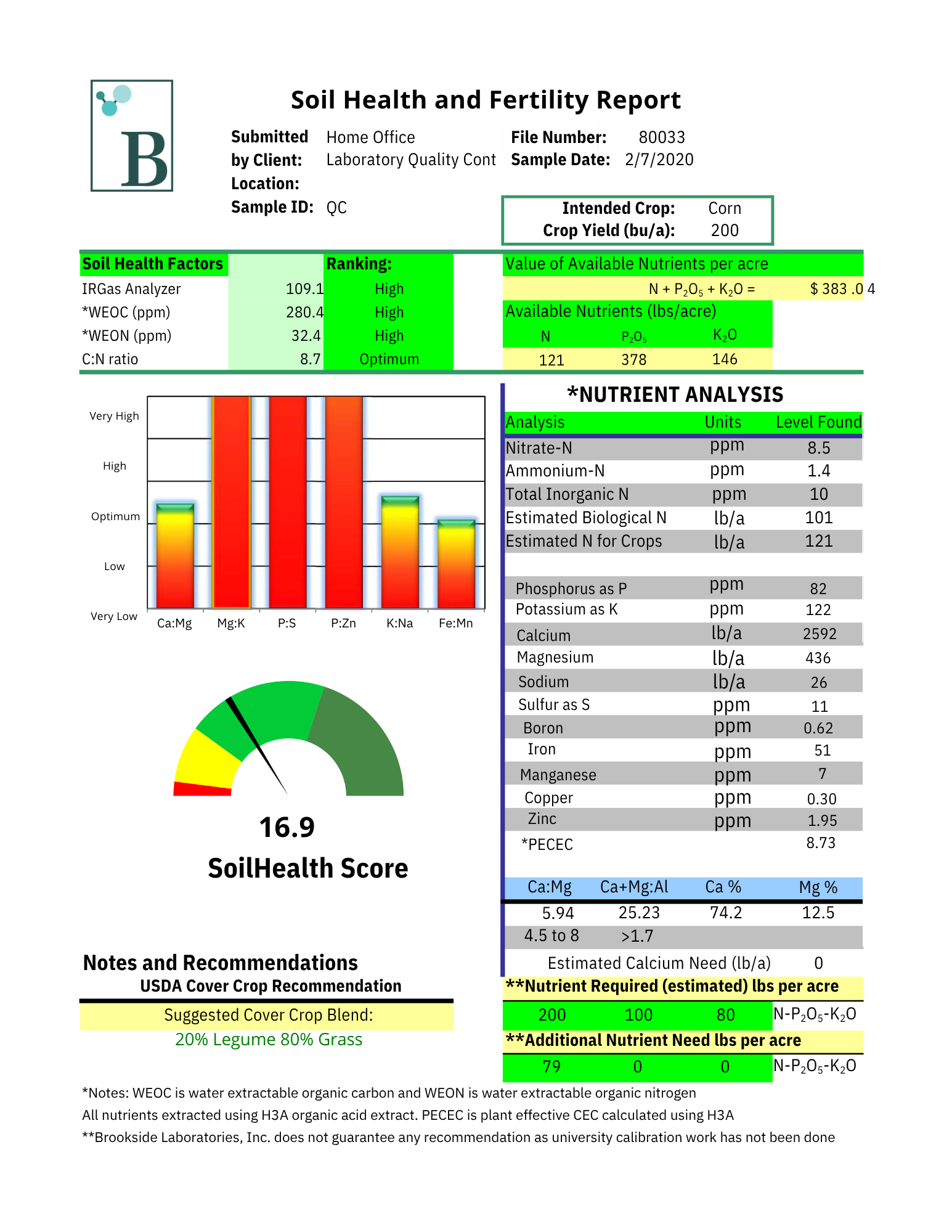
The Brookside Soil Health Test combines conventional soil analysis with biological measurements to evaluate:
- Microbial activity
- Carbon cycling
- Nitrogen cycling
- Soil structure
- Nutrient availability
- Soil balance
By combining these measurements, consultants and growers can identify opportunities to improve productivity while building a more resilient cropping system.
How Can it be used?
- It can be used to compare the condition of two farms that are being considered for purchase or rent. If purchase/rent price are the same then the farm with the best soil health indicators will have more “bang for the buck.”
- It can be used to assess a management practice (i.e. tillage versus no-tillage, cover crops versus no cover crops, manure versus no manure, etc…).
- The test can be used for trouble shooting “problem” areas within a field because it provides both biological and chemical information.
- The soil health test can be used to make N, P, K, and lime recommendations (it can do micronutrients too, but since the methodology is so new we are still learning the exact “critical” levels).
Sample Collection & Submission
Submitting a soil health sample is simple.
Most soil health samples follow the same collection and shipping procedures as standard chemical soil samples.
Sampling protocol:
- Collect samples using standard Brookside sampling procedures.
- Ship samples using normal shipping methods.
- Most analyses require samples to be dried and ground before testing.
- Composite sampling is recommended because soil health management zones often differ from traditional fertility zones. Some analyses, such as wet aggregate stability, require different handling procedures.
Laboratory Processing
Laboratory processing varies depending on the analysis being performed.
Many soil health analyses require samples to be dried and ground before processing. Samples are carefully weighed rather than scooped to ensure consistency and accuracy.
Standard laboratory procedures include:
- Respiration analysis
- H3A extraction
- Total organic carbon and total nitrogen extraction
- Standard pH, electrical conductivity, and organic matter measurements.
Questions?
For additional information about soil health testing, sample submission, or interpreting results, please contact the laboratory at:
Email: info@blinc.com
Phone: 419-977-2766
Or contact your local Amplify Consultant
Code
S019A
Soil Health Tool (Haney Test) with pH, 1:1 EC, and OM includes: H3A-4 Extractable Ca, Mg, K, Na, S, P, Mn, Zn, B, Fe, Al, Phosphate (PO4-P), Available Nitrogen (NO3-N + NH4-N), Water Extractable Organic Carbon and Total Nitrogen, Soil Respiration 24 hour (IRGA), pH, Sikora pH, Organic Matter, and 1:2 Soluble Salts
NOTE: Results are then used to assess overall soil health
S019
Soil Health Tool (Haney Test), includes: H3A-4 Extractable Ca, Mg,K, Na, S, P, Mn, Zn, B, Fe, Al, H3A-4 Extractable Phosphate (PO4-P), H3A-4 Extractable Available Nitrogen (NH4-N + NO3-N), Water Extractable Organic Carbon and Water Extractable Total Nitrogen, Soil Respiration 24 hour (IR Gas Analyzer)
NOTE: Results are then used to assess overall soil health
S113
CO2 Respiration 24 hour (IR Gas Analyzer)
S138
Total Carbon
S112
Total Nitrogen
S139
Total Organic Carbon (Acid Treated)
S273
Wet Aggregate Stability
S241
Permanganate Oxidizable Carbon (POXC)
S242
Autoclaved Citrate Extractable (ACE) Protein
S171
Texture by Hydrometer - %sand, %silt, %clay